Loading...
← Back to Blog
SEO & AI Search · 6 min read
SEO vs GEO vs AEO: What’s the Difference and Which One Does Your Business Need?
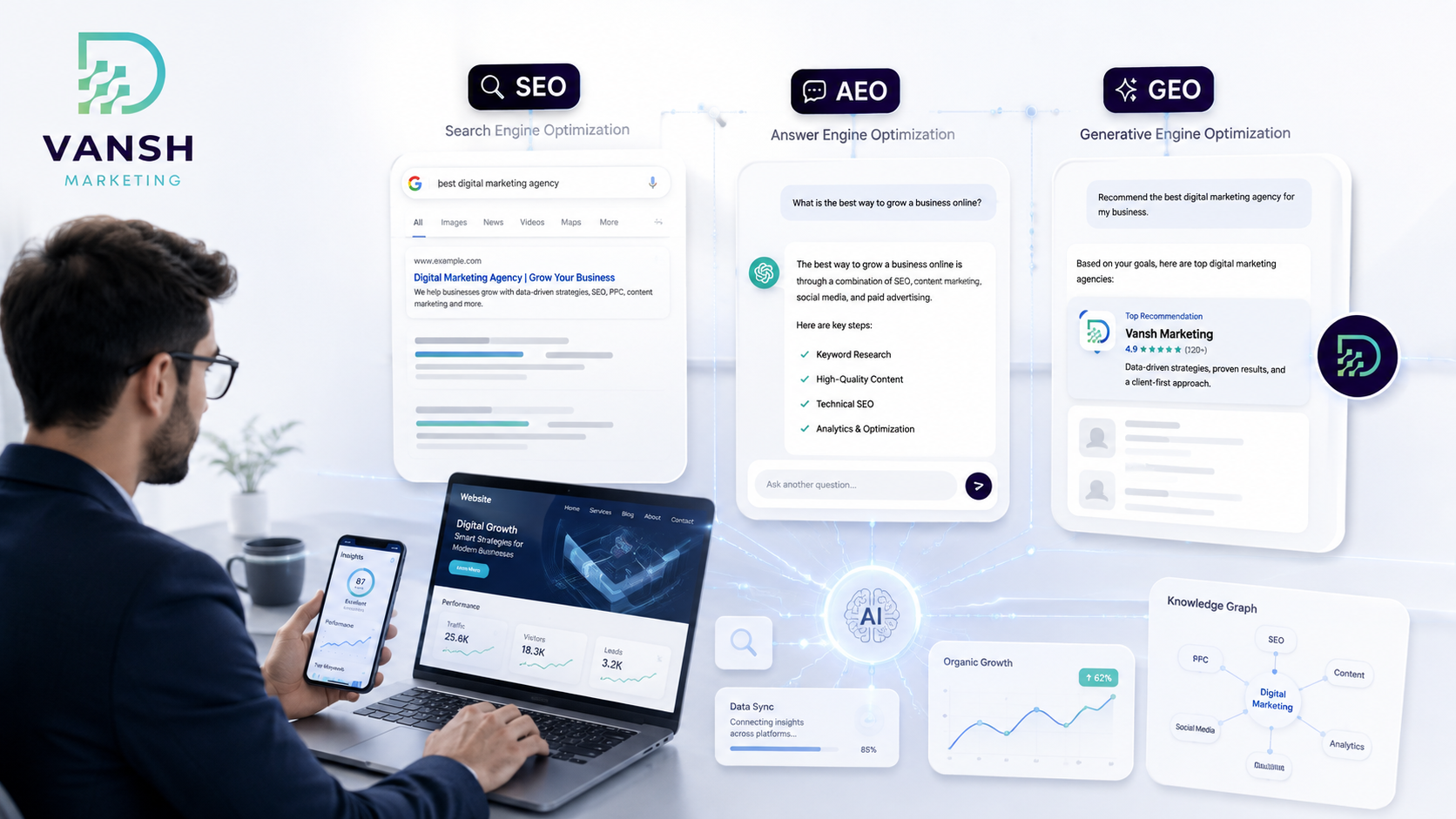
SEO vs GEO vs AEO: What’s the Difference and Which One Does Your Business Need?
Search is changing.
People still use Google to find websites, businesses, products, and services. But they are also asking complete questions through AI-powered search tools, voice assistants, and conversational platforms.
This has made three terms increasingly important in digital marketing:
SEO — Search Engine Optimization
AEO — Answer Engine Optimization
GEO — Generative Engine Optimization
They are connected, but they serve different purposes.
Understanding the difference can help your business build a stronger search strategy.
What Is SEO?
Search Engine Optimization (SEO) is the process of improving a website so it can be discovered and ranked for relevant searches.
SEO includes areas such as:
- Website structure
- Technical SEO
- Content
- Keywords
- Internal linking
- Backlinks
- Page experience
- Local SEO
For example, a Mumbai business may optimise its website for searches such as:
"digital marketing agency in Mumbai."
The goal is to make the business easier to find when potential customers search for relevant services.
SEO remains an important foundation for online visibility.
What Is AEO?
Answer Engine Optimization (AEO) focuses on creating content that directly answers the questions people ask.
Traditional searches may be short:
"SEO agency Mumbai"
A conversational search could be:
"How do I choose an SEO agency for my business in Mumbai?"
AEO focuses on answering questions like these clearly and directly.
AEO-friendly content commonly uses:
- Clear questions and answers
- Simple explanations
- Useful headings
- Short paragraphs
- FAQs
- Step-by-step information
The main idea is simple:
Don't just target the search. Answer the question behind it.
What Is GEO?
Generative Engine Optimization (GEO) focuses on improving how AI-powered systems understand and represent a business, its expertise, products, services, and information.
AI systems may use information from different sources when generating responses.
That makes it important for businesses to maintain clear and consistent information across their digital presence.
GEO can involve areas such as:
- Website content
- Business information
- Structured data
- Reviews
- Relevant online mentions
- Author information
- Company information
- Industry expertise
- Consistent business details
The goal is to make your business easier for AI systems to understand correctly.
SEO vs AEO vs GEO: What Is the Difference?
The simplest way to understand them is:
SEO helps your business get found.
AEO helps your business answer questions.
GEO helps AI systems understand your business and its context.
These strategies should not be treated as competitors.
They work together.
A business can use SEO to build search visibility, AEO to answer customer questions, and GEO to strengthen its presence across AI-powered discovery.
Which One Does Your Business Need?
For most businesses, the answer is not just one.
You need a combination of all three.
Start with SEO because your website needs a strong technical and content foundation.
Then add AEO by identifying the questions customers ask and answering them clearly.
Finally, strengthen your GEO strategy by making your business information accurate, consistent, useful, and easy to understand across your online presence.
How to Build an SEO, AEO and GEO Strategy
1. Build a Strong SEO Foundation
Start with your website.
Make sure you have:
- Clear service pages
- Easy navigation
- Mobile-friendly pages
- Useful content
- Internal links
- Proper technical SEO
- Accurate business information
A strong foundation makes every other optimisation effort more effective.
2. Create Content Around Customer Questions
Don't create content only around keywords.
Think about what your customers actually ask.
For example:
"How does AI automation help a small business?"
"What should I check before choosing an interior designer?"
"How can a real estate company generate better leads?"
These questions can become blog topics, FAQs, service-page sections, and supporting content.
3. Make Your Business Information Consistent
Check your information across:
- Website
- Google Business Profile
- Social media
- Business directories
- Industry websites
- Review platforms
Your business name, services, contact details, locations, and other important information should be accurate and consistent.
4. Create Helpful Content
Don't publish content just to fill your website.
Create content that solves real problems.
Explain:
- What your service does
- Who it is for
- How it works
- Common mistakes
- Important considerations
- Frequently asked questions
Useful content gives customers a reason to trust your business.
A Simple Example
Imagine an interior design company in Mumbai.
Its SEO strategy could target:
"Interior designer in Mumbai."
Its AEO content could answer:
"How much planning is needed before starting a home interior project?"
Its GEO strategy could make sure AI systems can clearly understand:
- What the company does
- Which locations it serves
- What types of projects it handles
- Which interior services it provides
- What information customers can rely on
One business can use all three strategies without creating three separate marketing systems.
Does GEO Replace SEO?
No.
SEO and GEO solve different problems.
SEO remains important for helping search engines discover and understand webpages.
GEO focuses more on how AI-powered systems understand and use information when generating responses.
Businesses should therefore treat GEO as an additional layer rather than a replacement for SEO.
Does AEO Replace SEO?
No.
AEO also works alongside SEO.
A technically strong website is still important. AEO simply adds a stronger focus on direct answers, conversational questions, and content structure.
The better approach is:
SEO + AEO + GEO
rather than choosing one over the others.
Common Mistakes Businesses Make
Avoid these mistakes when building your search strategy:
- Focusing only on keywords
- Repeating keywords unnaturally
- Creating thin service pages
- Ignoring customer questions
- Publishing generic AI-generated content without review
- Keeping outdated business information
- Ignoring structured data
- Creating content without a clear purpose
Your content should always be written for real people first.
How Vansh Marketing Approaches Modern Search
At Vansh Marketing, we combine SEO, AEO, and GEO to help businesses build a stronger digital presence.
Our approach can include:
- SEO
- AEO
- GEO
- Local SEO
- Google Business Profile Optimization
- Content Marketing
- Website Development
- AI Automation
- Lead Generation
The goal is straightforward:
Make your business easier to find, easier to understand, and easier to trust.
For businesses in Mumbai and across India, a combined search strategy can help create a stronger foundation for both traditional search and AI-powered discovery.
Key Takeaways
SEO, AEO, and GEO have different roles.
SEO helps you get found.
AEO helps you answer questions.
GEO helps AI systems understand your business.
You don't have to choose only one.
A strong digital strategy brings them together through useful content, accurate information, technical optimisation, and a clear understanding of customer needs.
Frequently Asked Questions
What is the difference between SEO, AEO and GEO?
SEO focuses on search engine visibility. AEO focuses on answering user questions clearly. GEO focuses on improving how AI-powered systems understand and represent a business and its information.
Which is more important, SEO or GEO?
Neither replaces the other. SEO remains an important foundation, while GEO addresses AI-powered discovery and generative search experiences.
Is AEO only useful for AI search?
No. AEO principles such as clear answers, strong content structure, and question-based content can also support traditional search and voice-based searches.
Can small businesses use GEO?
Yes. Small businesses can start by improving their website content, business information, reviews, structured data, and overall online consistency.
How should a business start with SEO, AEO and GEO?
Start with your website. Fix basic SEO issues, create useful content around customer questions, and make sure your business information is accurate and consistent across important online sources.
Enjoyed this article?
Get in touch with us to implement these ideas for your business.
100% Free · No Obligation
Want to Multiply Your Brand's ROI?
Book a free audit - we'll show exactly where the opportunity is.